Your SEO Agency Cannot Compete With Agentic SEO That Publishes, Tests, and Rewrites Itself
The next search advantage is not a better keyword spreadsheet. It is an autonomous content engine that finds the gap, builds the page, watches performance, and improves the asset before a human agency even opens the report.
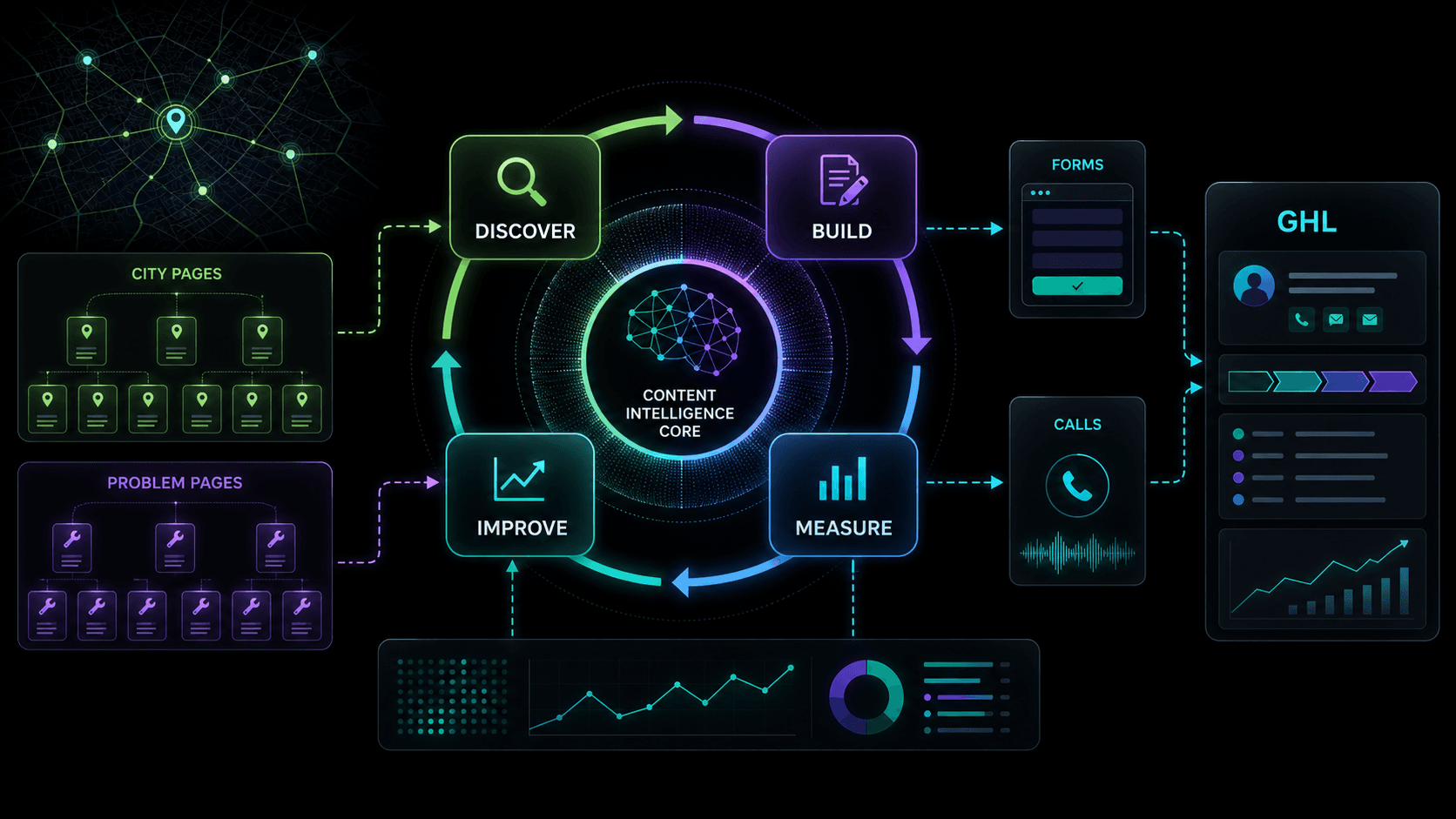
The agency workflow is too slow for AI search
Local service search used to reward steady execution. Publish service pages. Build citations. Ask for reviews. Update Google Business Profile. That still matters, but it is no longer enough. AI-assisted search rewards coverage, freshness, and clarity at a much faster cadence.
An agency that waits 30 days to review performance is already late. The market moved. Competitors published. Search results shifted. Buyers asked new questions. The system needs to notice that without waiting for a meeting.
The pace mismatch is the real threat. Owners are not losing because they forgot SEO exists. They are losing because the traditional workflow cannot produce enough relevant coverage, test it, and update it fast enough to match how people search now.
What an autonomous SEO engine actually does
Agentic SEO starts with intent. It maps the real ways buyers describe their problems, then organizes pages around service, location, urgency, seasonality, equipment, symptoms, and price questions. From there, the system creates and improves assets against those patterns.
The key is the feedback loop. Publish is not the finish line. The system checks what was indexed, what earns impressions, what converts, what needs expansion, and what should be rewritten. Humans set the strategy. The agent handles the operational grind.
For Codexo, the engine is designed around local service businesses, not generic media sites. That means the system cares about service areas, job types, seasonal demand, emergency modifiers, quote intent, after-hours behavior, and whether the page is likely to produce a real conversation.
Content volume is not the moat. The moat is a system that keeps learning from the market after every page goes live.
The page types that matter now
Most service sites have a home page, a few service pages, and maybe a handful of city pages. That is no longer enough coverage. Buyers search for problems before they search for companies. They search for symptoms before they know the service category. They search with urgency, price anxiety, and local modifiers.
The autonomous engine builds around that reality. City pages cover service areas. Problem pages cover symptoms. Comparison pages handle decision moments. Emergency pages capture urgent demand. Maintenance pages create repeat revenue. FAQ expansions answer the questions that keep buyers from booking.
The important part is structure. Random AI pages do not create a durable advantage. A connected cluster does. Each asset should support another asset, explain a real buyer problem, and make the next step obvious.
SEO only matters if the lead is captured
The old SEO industry treated ranking as the win. For Codexo, ranking is only a signal. The win is a booked job, a qualified quote request, a revived dead lead, or a call answered before the competitor gets a chance.
That is why Agentic SEO has to connect to GHL. Pages capture demand. Forms and calls become contacts. Voice AI handles intake. Automations follow up. Reporting connects the page to pipeline movement. Without that loop, SEO is still just traffic theater.
This is where most SEO programs fail operationally. They celebrate traffic and ignore response time. They publish pages and do not wire the forms. They generate calls but do not classify the caller. They create demand and then let the business mishandle it.
What we have done differently
We built the platform so search content, CRM organization, AI voice, and follow-up are parts of the same system. The content layer captures intent. The form and call layer captures the person. GHL organizes the record. Automations move the relationship forward.
That lets us build content with a specific operational end state. A page for emergency HVAC repair should not have the same conversion flow as a page for replacement estimates. A page for a maintenance plan should not trigger the same follow-up as a one-time repair. The system can treat each path differently.
This is the practical difference between agentic SEO and AI blogging. We are not adding content to the internet. We are building pages that feed a revenue machine.
The warning for service businesses
If your competitor adopts agentic SEO first, they will not just publish more pages. They will learn faster. They will see which services convert by city. They will know which objections show up in form submissions. They will adjust offers and follow-up while you are still reviewing a ranking report.
This is the same pattern we saw in CRM automation and AI voice. The early operator compounds. The late operator eventually buys the baseline tool, but with no historical data and no operating advantage.
The gap is not theoretical. A service business that learns every month gets sharper messaging, cleaner follow-up, better local coverage, and stronger conversion. A business that waits gets a website that slowly becomes less useful while the market keeps moving.
Search is becoming an operating system.
We will show how Agentic SEO connects pages, calls, forms, GHL, and follow-up into one revenue loop.
Book a Strategy Call