This Agentic SEO Platform Will Disrupt a Billion-Dollar Industry
Traditional SEO is still sold as retainers, reports, and slow content calendars. Agentic SEO changes the operating model. It turns search growth into a system that researches, publishes, tests, rewrites, and expands while your competitors are still waiting on a monthly meeting.
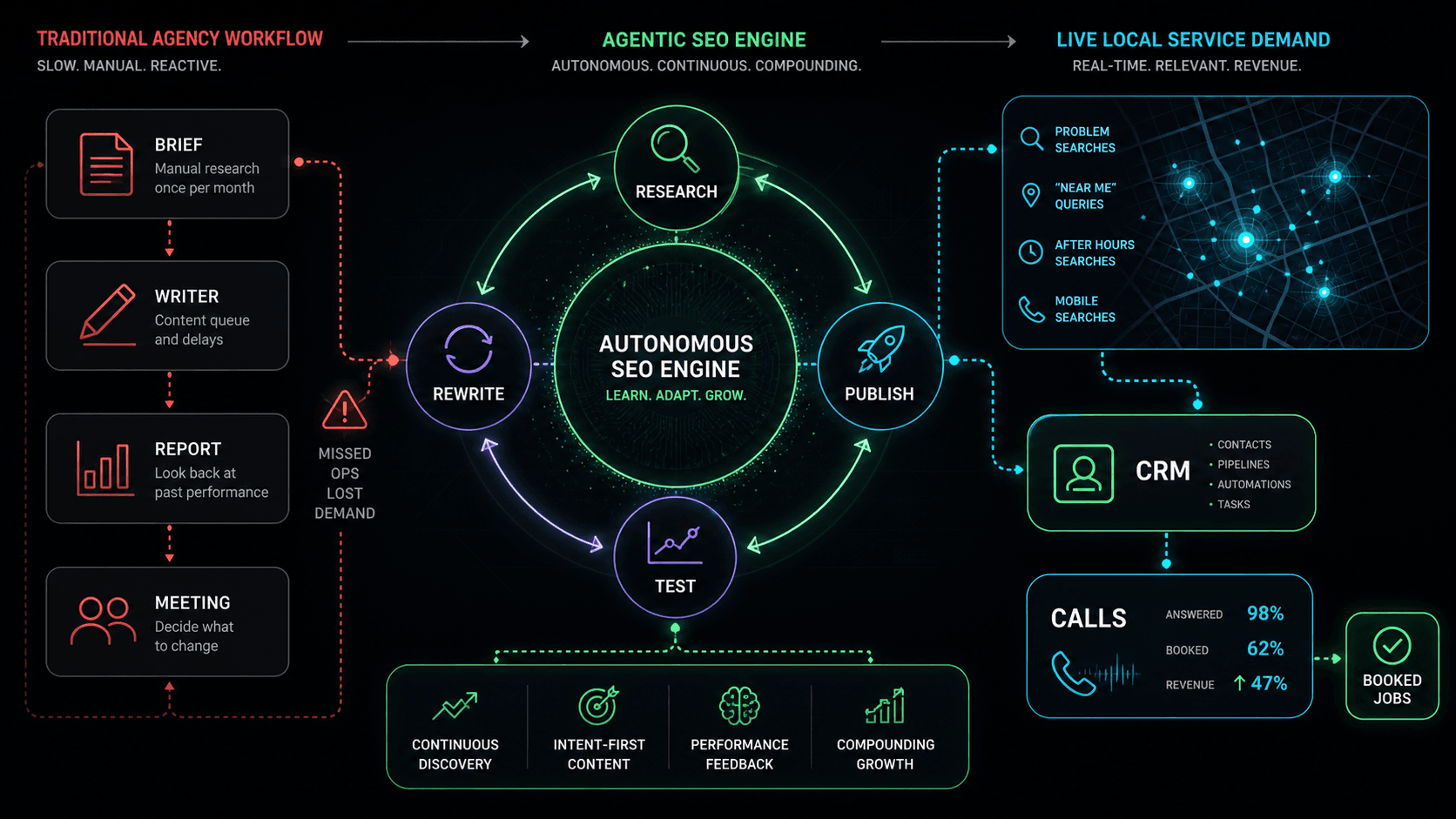
The SEO industry is built around human delay
Most SEO agencies still run the same loop. Keyword research happens once. Content briefs sit in a queue. Writers produce pages. Someone checks rankings weeks later. Then the team debates what to change. That loop made sense when publishing was slow and search behavior moved slowly.
Search is no longer moving slowly. AI answers, zero-click results, local map behavior, review velocity, and service-area intent are changing at the same time. The old agency model cannot react fast enough because the workflow itself is the constraint.
The biggest problem is not that agencies lack smart people. The biggest problem is that the delivery model is built around batches. Monthly reports, monthly content calendars, monthly strategy calls, monthly revisions. Agentic systems do not wait for the calendar to turn over.
The disruption is not that AI writes content. The disruption is that agentic SEO removes the waiting room around every SEO decision.
What the Codexo Agentic SEO platform does
We built an Agentic SEO platform to handle the parts of search growth that should no longer be manual. It identifies service clusters, maps local intent, drafts pages, checks coverage gaps, monitors performance signals, and pushes revisions based on what the market is showing.
For service businesses, the target is not vanity traffic. The target is booked calls from real buyers in real service areas. The platform is designed around revenue pages, city pages, problem pages, and conversion paths that feed the CRM.
The platform is not a blog generator. It is a search operations layer. It can look at a vertical, map the services, build city and problem clusters, identify missing supporting pages, and produce the next batch of useful assets based on gaps in the current site.
Once pages are live, the system’s job continues. It watches which pages attract impressions, which pages need more specificity, which calls to action are underperforming, and where the content should be expanded. That is the difference between AI content and agentic SEO.
What we built that changes the economics
Codexo’s Agentic SEO platform is built around repeatable local service growth. The system can generate structured service-area coverage, problem-based pages, internal linking plans, title variations, schema direction, FAQ expansions, and conversion sections tied to real buying intent.
We also connect the content layer to the revenue layer. A page should not just rank. It should create a lead record, preserve source context, trigger the right follow-up, and help the business understand which service categories are producing qualified conversations.
This is why the platform matters for owners. It does not replace strategy. It replaces the manual production drag that made strategy expensive to execute. One operator can now create and maintain a search footprint that used to require a full content department.
AI search punishes static websites
A static website cannot keep up with the number of ways customers now ask for help. They search by problem, location, urgency, cost, symptom, equipment type, and timing. One generic service page cannot cover that intent.
Agentic SEO builds and maintains the intent layer. It does not publish random AI articles. It creates structured coverage around the services that produce revenue, then keeps improving the pages as patterns appear.
AI search also changes what useful content looks like. Thin city pages and keyword-stuffed service pages are easy to ignore. Pages need direct answers, local proof, clear process, pricing context where appropriate, service-area clarity, and a conversion path that does not force the buyer to hunt.
Why this threatens the billion-dollar SEO services market
The SEO services market is built on selling labor wrapped in expertise. Agentic SEO compresses the labor. Research, first drafts, rewrite candidates, cluster expansion, metadata variants, internal link opportunities, and content refreshes can all move faster than traditional retainers can support.
That does not make expertise worthless. It makes slow fulfillment worthless. The agency or operator who knows what to build and uses agentic systems to ship it will underprice and outperform the team still billing for manual assembly.
The scary part for legacy agencies is that the customer will feel the difference. More relevant pages. Faster iteration. Better conversion paths. Less waiting. Once buyers see that pace, the old monthly retainer starts to look like a tax on slowness.
Why this matters for operators with trucks
A 10-truck service business does not need thought leadership. It needs local demand capture. If a homeowner searches for a same-day repair, a replacement estimate, or a seasonal service issue, the business needs a page that matches the problem and routes the lead immediately.
That is why the platform connects back to GHL. Search creates the demand. GHL organizes the lead. Automations follow up. Voice AI answers when the lead calls. Agentic SEO is not a marketing add-on. It is the top of the operating system.
When that loop is in place, SEO stops being a mystery channel. Owners can see which local pages are producing form fills, which calls came from service pages, which offers created booked jobs, and which cities deserve more content investment.
The SEO retainer model is about to look slow.
We will show you how the Codexo Agentic SEO platform builds service-area coverage and routes demand into your CRM.
Book a Strategy Call