These New AI Voice Updates Will Replace Every Assistant Who Only Answers Phones
ElevenLabs just pushed voice agents further past basic call answering. For service businesses, the risk is no longer missing calls. The risk is keeping a human-only front desk that cannot see context, trigger workflows, or follow up fast enough.
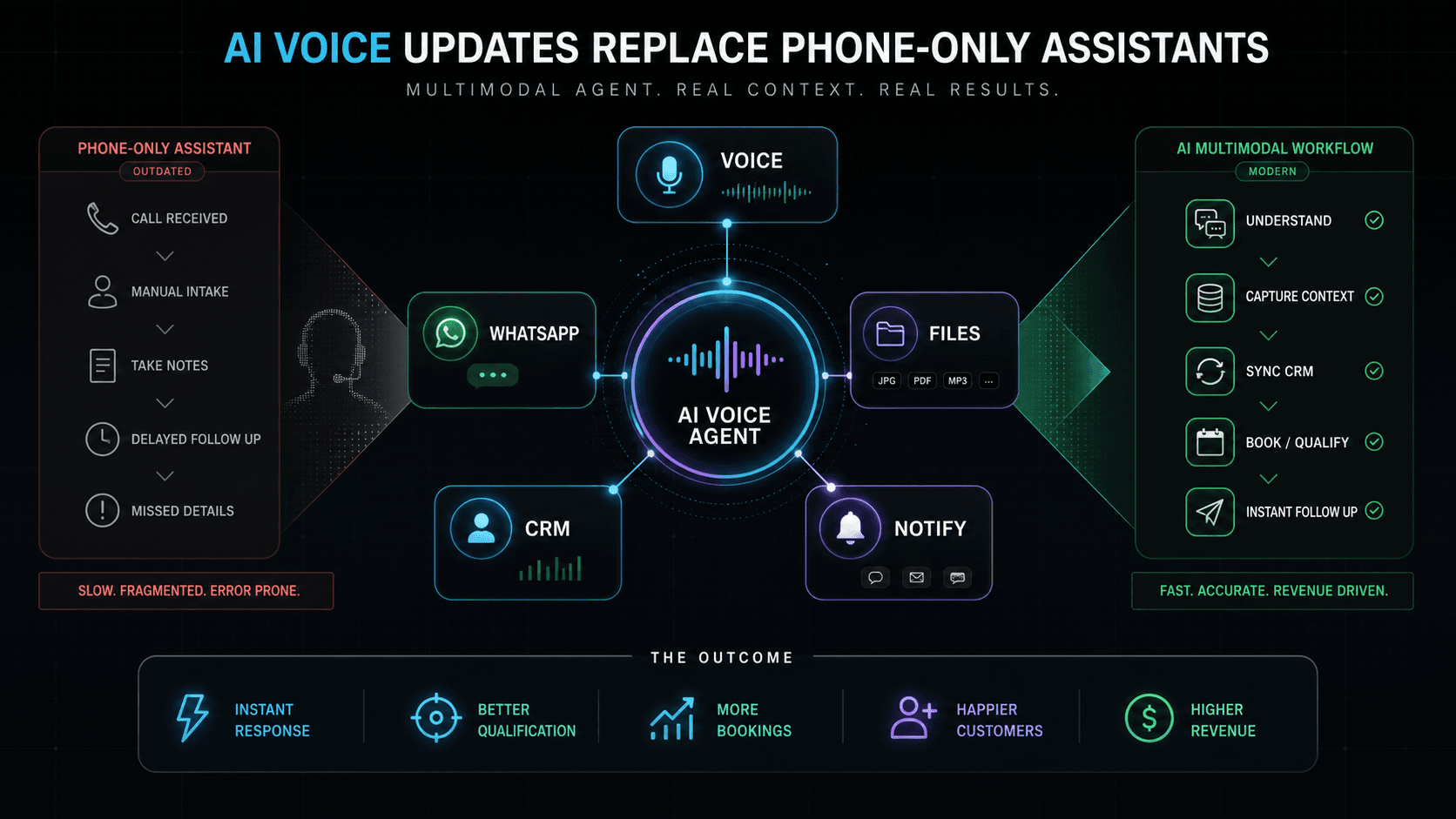
Voice agents are not just voices anymore
The newest ElevenAgents updates are not cosmetic. ElevenLabs now supports richer customer interactions across voice, chat, WhatsApp, web widgets, files, images, audio notes, contacts, and locations. That matters because real service calls rarely stay inside one clean channel.
A customer can call about a leak, text a photo, send their location, and expect the business to understand the whole situation. A normal assistant has to collect, copy, paste, and explain. A properly configured voice agent can keep the context together and push the right data into the CRM.
This is the shift owners should pay attention to. Voice AI is leaving the novelty phase and entering the operations phase. The agent is not valuable because it sounds impressive for 30 seconds. It is valuable because it can carry the intake across channels and convert messy customer context into structured business data.
The assistant who only answers the phone is competing with an agent that can answer, inspect, route, log, and trigger the next step.
The front desk becomes the bottleneck
In a 10-truck service business, the front desk is not a greeting function. It is the intake layer for revenue, scheduling, dispatch, customer communication, and follow-up. Every missed detail becomes a bad job note, a confused technician, or a lead that never books.
AI voice changes the math because it can hold the intake standard every time. It asks for the address. It captures the service issue. It checks whether the request is urgent. It records the objection. Then it pushes that information into GHL where automations, tags, pipeline stages, and notifications can take over.
That does not mean the best office people disappear. It means their job changes. They stop being forced to answer repetitive intake questions all day and start managing exceptions, high-value customers, escalations, and quality control. The repetitive layer becomes software. The judgment layer stays human.
The new standard is answer, qualify, record, and trigger
A modern call intake system has four jobs. It answers instantly. It qualifies the request. It records the details cleanly. It triggers the correct next step. Most businesses still only measure the first job. They ask whether the phone was answered. That is not enough anymore.
If a caller asks about pricing, the system should know what to say and when to offer a human callback. If a caller needs emergency service, the system should flag urgency and notify the team. If the caller is a dead lead returning after three months, the CRM should know that history before the conversation is over.
This is where Codexo’s work sits. We are not just installing a voice agent. We are defining the intake logic, the CRM fields, the follow-up rules, the escalation paths, the business hours behavior, and the human handoff conditions. The voice is the interface. The system around it is the product.
Why we build on ElevenLabs
Codexo voice systems are built on ElevenLabs because the voice layer has to sound natural under pressure. A service caller is usually frustrated, hurried, or comparing options. The agent cannot sound like a menu tree. It has to sound calm, direct, and useful.
The Codexo layer connects the voice agent to the operating system around it. ElevenLabs handles the conversation. GHL organizes the contact, workflow, and follow-up. Our infrastructure decides what data matters, what automation fires, and when a human needs to be notified.
We also build the prompt architecture around the vertical. A pool caller, HVAC caller, roofing caller, and commercial facilities caller do not need the same intake. The agent needs to know the business’s service radius, offer structure, job types, appointment rules, emergency criteria, and what information the dispatcher actually needs.
What we have already built into our voice stack
Our current voice stack is built to capture lead source, caller intent, urgency, service category, location, preferred appointment window, qualification status, objections, and recommended next action. The agent can notify the team when a human needs to intervene and can keep the CRM from becoming a junk drawer of half-written notes.
For after-hours calls, the system can answer consistently without telling customers to wait until morning. For missed calls, it can trigger immediate callbacks or SMS follow-up. For repeat callers, it can carry CRM context into the interaction so the caller does not feel like the business forgot them.
This is the part most AI demos skip. The call is only one moment. The real revenue lift comes from the follow-up that happens after the call, the pipeline movement that happens without manual cleanup, and the notification that reaches the right person before the lead goes cold.
Who gets replaced first
AI voice will not replace every great operator. It will replace the role where the job is mostly answering repeated questions, collecting the same fields, routing calls, and remembering to follow up. That is the part of the business most owners already know is fragile.
The winners will keep their best people and remove the work that burns them out. The losers will defend manual intake until the competitor across town answers every lead in under three seconds, books after hours, and never forgets the second touch.
The uncomfortable truth is simple: if the assistant role is not connected to revenue judgment, customer recovery, scheduling strategy, or exception handling, the software is coming for it. Not someday. Now.
Want to see what your phone intake should become?
We will map your current call flow and show where ElevenLabs voice agents, GHL, and Codexo automation replace manual intake without losing control.
Book a Strategy Call