ElevenLabs Just Made Voice Agents Multimodal. Your Call Center Is the Next Bottleneck
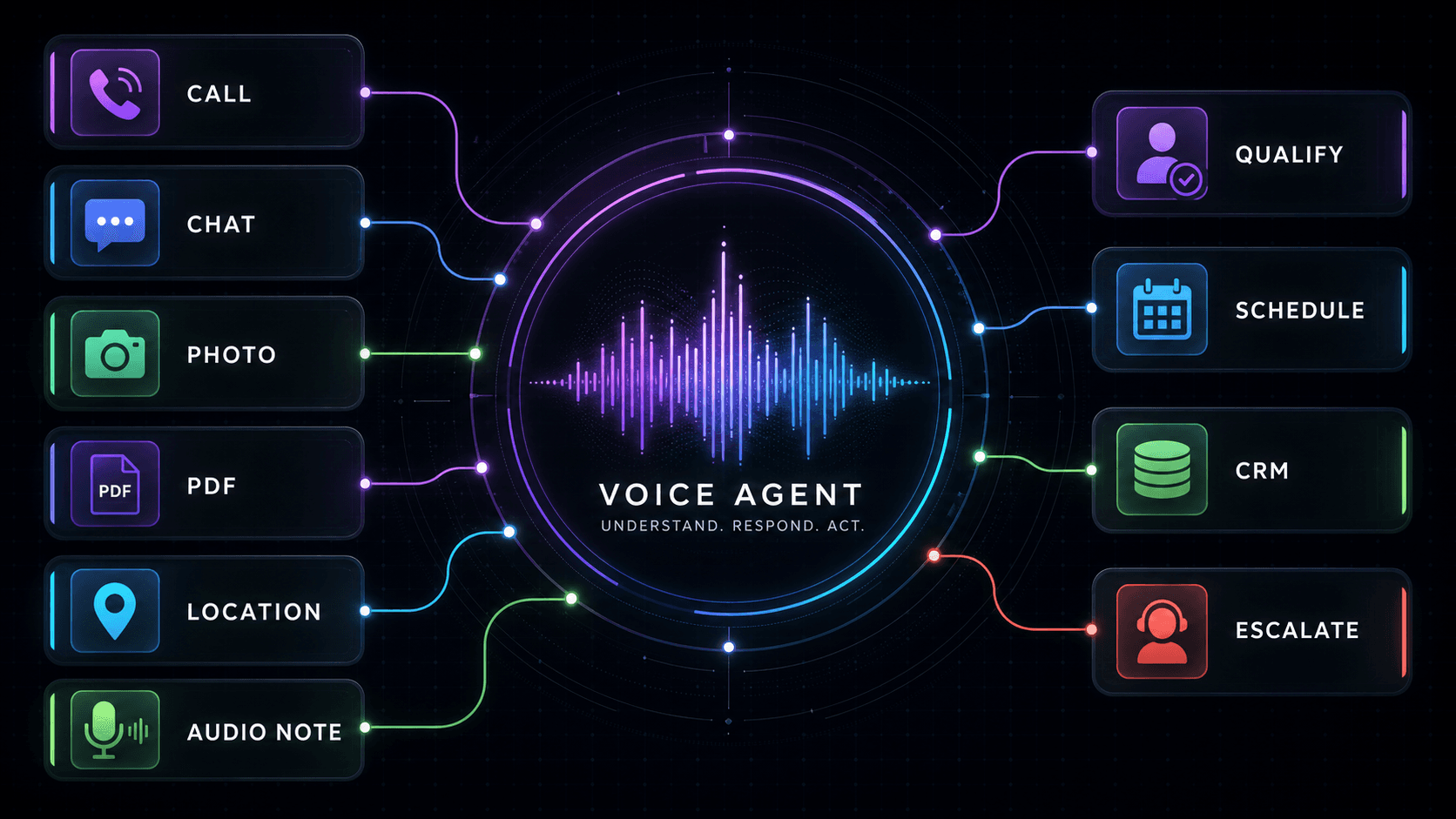
ElevenLabs now lets agents process more than talk. Images, files, audio notes, contacts, and locations can become part of the same customer conversation. That is a direct threat to every service business still treating the phone as a disconnected channel.
The channel boundary is disappearing
The newest ElevenAgents release expands the agent from voice and chat into richer inputs across WhatsApp and web widgets. A customer can send a photo, PDF, audio message, contact, or location, and the agent can keep context across the interaction.
For service businesses, this is not a novelty. Photos of equipment, locations, invoices, inspection notes, and proof documents are part of the job. The ability to process them inside the same conversation changes how intake should work.
This is a major change because most customer operations are still designed around a single channel. Phone team over here. Website chat over there. Form submissions somewhere else. Photos buried in text threads. Voice notes ignored. Multimodal agents make that fragmentation look outdated.
Why the call center becomes the bottleneck
Most call centers are built around call handling, not context handling. They answer, ask questions, put notes somewhere, and hope the next person understands. That breaks when the customer journey moves between voice, SMS, WhatsApp, email, and web chat.
A multimodal voice agent can carry context across the channels. It can take the call, request a photo, keep the same issue open, and route the output to GHL for follow-up and team visibility.
The pressure will show up first in high-volume local businesses. If a caller can send a photo of a broken part while the agent is qualifying the request, why should the dispatcher wait for a human to ask for it later? If the agent can collect location context, why should the office manually clean the address?
The future call center is not a room full of people answering phones. It is an AI intake layer with humans stepping in where judgment actually matters.
The industry is moving from conversation to resolution
The first wave of AI voice was judged on whether it sounded human. That still matters, but it is not enough. The next wave is judged on whether it resolves the request or gets the business to the right next action with complete context.
ElevenLabs is pushing in that direction with multimodal inputs, tool use, workflow support, webhooks, agent monitoring, and platform controls that make agents more useful in actual operations. The voice is becoming one part of a broader agent platform.
That is why these updates matter to Codexo. They expand what our intake systems can capture before the human team ever touches the record. Better inputs create better automations. Better automations create faster response. Faster response creates more booked work.
Field service companies feel this first
HVAC, plumbing, electrical, roofing, garage door, and pool companies all deal with context-heavy requests. The customer rarely knows the correct category. They know what they see, hear, smell, or need fixed. The system has to translate that into a clean job path.
That is why Codexo builds voice AI with operational routing, not just polite conversation. The agent should collect the evidence, classify urgency, create or update the CRM record, and notify the team when a human should step in.
A homeowner saying the AC is making a sound is less useful than a homeowner sending an audio note. A roofing caller describing a stain is less useful than a photo. A pool customer saying the equipment looks weird is less useful than a picture of the pump label. Multimodal intake gets the business closer to the actual problem.
How we design the workflow around it
The agent should not collect everything just because it can. That creates noise. Codexo designs the collection logic around the job type. Emergency calls need urgency and location. Estimate calls need scope and qualification. Support calls need account context and problem evidence.
From there, GHL becomes the operating layer. The contact record stores the interaction. Tags classify the request. Automations notify the team, send follow-up, or move the opportunity. If the caller needs a human, the escalation is based on criteria, not guesswork.
The result is a cleaner intake experience for customers and a cleaner work queue for the team. The office does not have to decode every messy conversation from scratch.
Why ElevenLabs is the right base layer
We build on ElevenLabs because the voice interface is only useful if people stay on the call. Expressiveness, turn-taking, latency, and channel support all matter when the caller is frustrated or ready to book.
Codexo adds the service-business layer around it: GHL integration, workflow logic, dispatch context, callback rules, after-hours behavior, and escalation paths. ElevenLabs gives the agent a voice. Codexo gives it a job.
That is the distinction owners should care about. A voice agent demo is not an operating system. A voice agent connected to CRM, field workflows, automations, and reporting can become one.
Your call center should already be multimodal.
We will show where ElevenLabs voice agents can remove manual intake and connect every customer interaction back to GHL.
Book a Strategy Call