Billion-Dollar Companies Do Not Ignore Email. Service Businesses Still Are.
Every large operator keeps an owned customer channel because paid attention gets expensive, search visibility changes, and social reach is rented. Service businesses usually have the better raw material: completed jobs, happy customers, reviews, referrals, seasonal need, and repeat work. The problem is that most of it never gets turned into a disciplined email system.
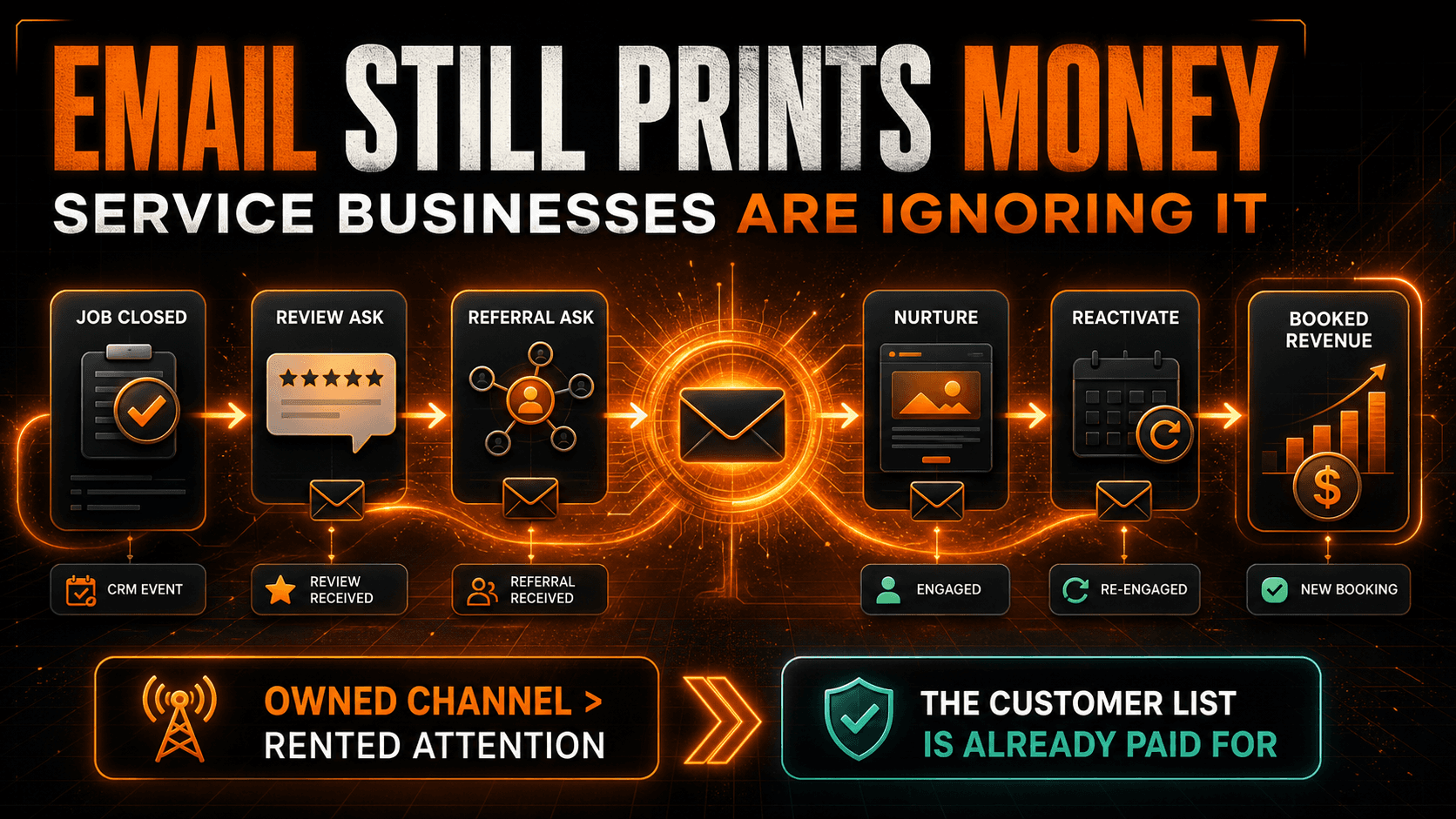
The billion-dollar lesson is not complicated: own the follow-up channel
Large companies do not treat email as an afterthought. They use it because it is owned, measurable, cheap to test, easy to segment, and close enough to the customer file to influence revenue. They do not rely on one platform, one search algorithm, or one social feed to keep demand warm.
That lesson matters even more for service businesses. A homeowner who just had a roof repaired, an HVAC system serviced, a pool opened, or a landscaping project completed is not just a past customer. They are a review opportunity, a referral source, a seasonal reminder target, and a future job if the business has the discipline to stay present.
The gap we keep finding is not that service operators lack relationships. The gap is that the relationships are trapped in invoices, missed texts, Google reviews, technician memory, and disconnected CRM notes instead of being turned into a timed communication system.
The newsletter is not the asset. The triggered customer file is the asset.
The strongest emails are tied to a real customer moment
The weak version of email marketing is a monthly blast sent to everyone because the business remembered it had a list. The strong version starts with an event: job completed, estimate sent, review received, referral submitted, maintenance window approaching, quote stalled, warranty expiring, or customer inactive for too long.
That is why email keeps showing up as one of the most durable marketing channels in public benchmarks. Recent email ROI reporting still clusters around strong returns per dollar spent, and automation keeps punching above its weight because timing is the advantage. The message lands when the customer context is still fresh.
For local service companies, the practical takeaway is simple. Do not start with a newsletter calendar. Start with the five moments where the business already has trust and the customer already understands the value delivered.
Reviews and referrals should be part of the same operating loop
Most businesses separate reviews, referrals, and email into different chores. Someone asks for a review when they remember. A referral program gets mentioned once. Email gets used for a holiday promotion. None of it compounds because none of it is connected.
The better loop is tighter. When a job closes, the customer receives a clean review request. When the review lands or the customer signals satisfaction, the next message asks for a referral in a way that feels natural, not desperate. If they refer, the CRM tags the source and starts a different path. If they do not, they still enter a useful nurture sequence built around seasonal timing, maintenance, and education.
This matters because service businesses win on trust density. A fresh review makes the next buyer more comfortable. A referral makes the next lead warmer. A useful email keeps the company remembered when the next need appears. Each piece helps the next one perform.
The best referral email does not ask a cold audience for a favor. It asks a satisfied customer to pass along a company they already trust.
Service businesses have an email advantage that ecommerce brands would pay for
A service company often knows the customer address, job type, invoice size, technician notes, appointment date, problem solved, seasonality, and whether the customer was happy. That is better segmentation than most generic newsletters ever get.
A roofing customer can get storm-season education. A pool customer can get opening and closing reminders. An HVAC customer can get maintenance prompts before the rush. A med spa client can get treatment follow-up and rebooking timing. A law firm lead can get a plain-language explanation sequence after an inquiry.
The point is not to send more email. The point is to stop sending the same email to every person. Billion-dollar operators segment because relevance is cheaper than volume. Local companies should do the same with the data they already collect.
The Codexo build turns email into a revenue instrument, not a content chore
Our service-business email build starts with the CRM events that already exist: new lead, booked appointment, completed job, paid invoice, review request, review received, referral submitted, no-show, estimate not accepted, and inactive customer. Those events decide the timing.
Then the system creates the message paths: review request, referral ask, missed-estimate recovery, maintenance reminder, seasonal campaign, reactivation, win-back, and customer education. Each path has a clear business reason, a stop condition, and a measurement target.
That is how the channel becomes useful. The owner can see which emails created replies, referrals, reviews, booked appointments, and revenue. Open rates are not the scoreboard. Booked work is.
Ignoring email is more expensive now because every other channel is getting noisier
Paid ads are more competitive. Local SEO is more complex. AI search is changing discovery. Social platforms decide how much of the audience sees a post. Reviews and referrals still matter, but they only compound when the business has a system that asks, records, routes, and follows up.
Email sits in the middle of that system. It is the quiet infrastructure that turns one good job into proof, one satisfied customer into a referral, one seasonal need into a reminder, and one old customer into another booked appointment.
The companies that act like billion-dollar operators will build the owned channel now. The companies that wait will keep buying attention they already earned once.
Your customer list should be producing reviews, referrals, and repeat work.
We can map the CRM events, email sequences, and attribution layer that turn completed jobs into a measurable service-business growth engine.
Book a Strategy Call