GHL Is the Brain. Service Fusion Is the Field System. We Connected the Two.
Service businesses do not need another dashboard. They need their customer system and field system to work as one operating layer. Codexo now connects GHL and Service Fusion so leads, jobs, estimates, automations, and AI voice stop living in separate worlds.
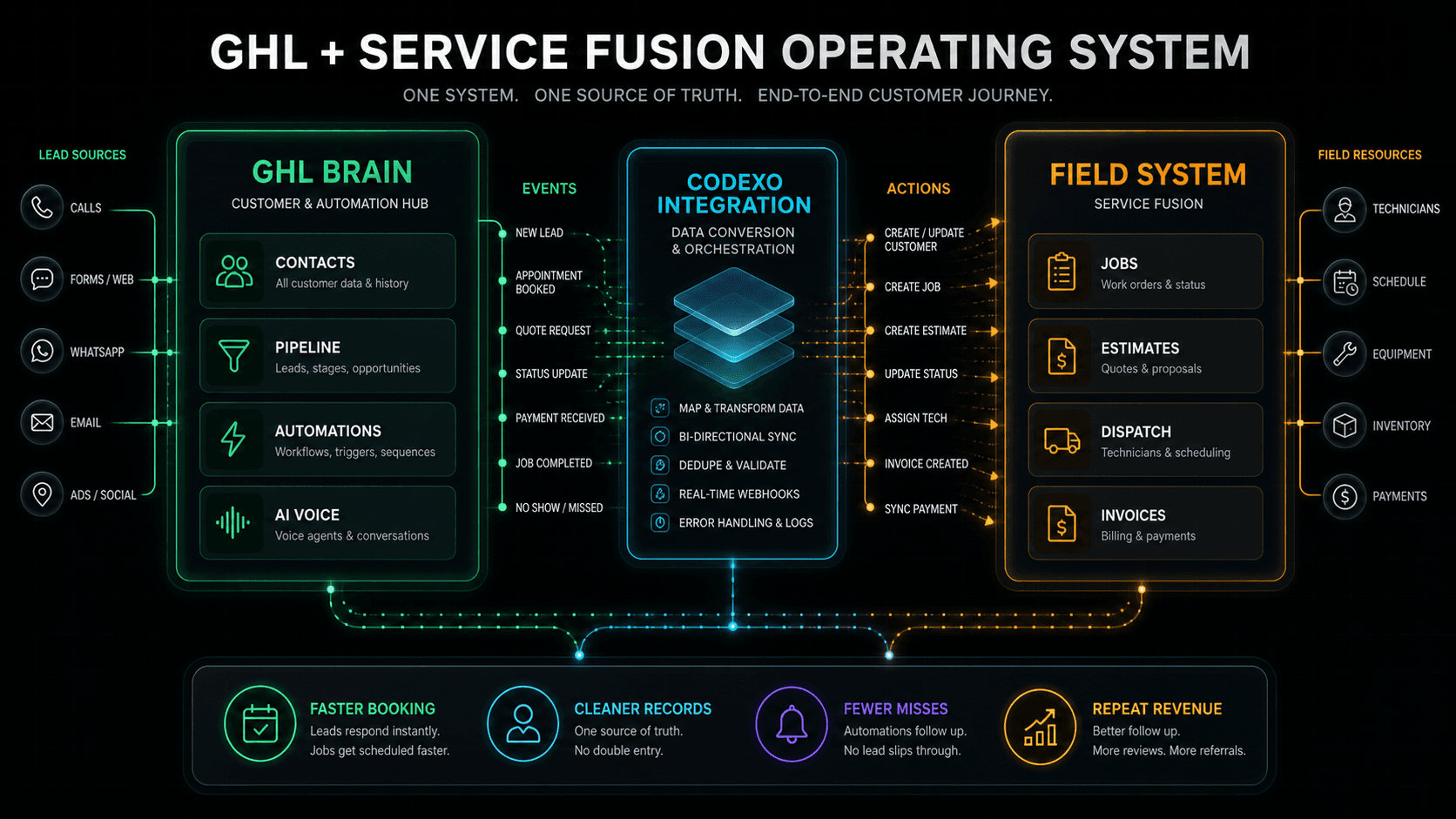
Each platform has a different job
GHL is strongest as the customer brain. It organizes contacts, conversations, pipelines, automations, calendars, forms, campaigns, tags, and AI voice workflows. It is where the business understands demand and drives follow-up.
Service Fusion is strongest as the field execution layer. It handles customers, jobs, estimates, equipment, technicians, scheduling, dispatch, invoicing, and field visibility. It is where work gets assigned, completed, and billed.
Trying to make one platform do both jobs perfectly usually creates friction. The smarter move is to let each platform do what it is good at, then connect the data and events that matter. That is the operating-system approach.
The disconnect costs more as the fleet grows
At small scale, disconnected tools are annoying. At 10 trucks and above, they become expensive. Leads get created in one system. Jobs get created in another. Estimate outcomes do not trigger follow-up. Completed jobs do not automatically create review or reactivation sequences.
The business starts paying people to act as an API between tabs. That is not a staffing solution. It is a sign the operating system is unfinished.
The cost shows up as slower booking, stale pipeline stages, missing review requests, delayed callbacks, duplicate records, and confused reporting. None of those failures look dramatic in isolation. Together, they create margin leak.
A dispatcher should not have to be the integration layer between your revenue system and your field system.
Events are the real automation fuel
Most businesses think about integration as moving records. That is only part of the story. The real value comes from events. A customer was created. A job was booked. An estimate was sent. A job was completed. A payment was collected. A status changed.
Each event can trigger a different customer experience. A new customer might receive onboarding. A completed job might receive a review request. An unsold estimate might enter a follow-up sequence. A missed appointment might notify the manager. An urgent call might escalate instantly.
When events are connected, automation becomes specific. When events are disconnected, automation becomes generic. Specific automation converts better because it responds to what actually happened.
What Codexo connects
The integration can connect customer creation, job creation, estimate activity, technician context, equipment context, and status changes back into GHL logic. The exact workflow depends on how the business sells, schedules, and follows up.
A new booked lead can update Service Fusion. A job event can update GHL. A completed job can trigger review requests and future maintenance reminders. An unsold estimate can enter a structured nurture path. AI voice can answer, qualify, and route with better context.
We also design guardrails. Duplicate detection matters. Field ownership matters. Error logs matter. Not every update should overwrite every other update. The integration has to respect the source of truth for each type of data.
Why AI voice gets stronger when the systems connect
AI voice is only as useful as the context around it. If the agent answers a call but cannot update the CRM, cannot understand whether the customer already has a job, and cannot trigger the right follow-up, it becomes a fancy answering machine.
When GHL and Service Fusion are connected, the voice agent can become part of operations. It can qualify a new lead, reference CRM context, route urgent calls, trigger notifications, and make sure the field system receives the right handoff when the customer is ready.
That is especially important after hours. A service business can capture demand when the office is closed, organize the record, and tee up the next action before the morning rush starts.
This is how service businesses get leverage
Leverage does not come from buying more software. It comes from turning the software into one system. The owner should see demand, booked work, follow-up, and customer history without asking five people for updates.
When GHL and Service Fusion are connected, the business has a cleaner path from lead to booked job to completed work to repeat revenue. That is the difference between a tech stack and an operating system.
Codexo’s role is to design that operating layer. We connect the tools, but more importantly, we define the workflow logic that makes the connection useful. The goal is not software elegance. The goal is a business that responds faster and leaks less revenue.
Your field system and CRM should not be separated.
We will map the data handoffs between GHL and Service Fusion and show what Codexo can automate first.
Book a Strategy Call