If Your Agency Does Not Know What llms.txt Is, You Are Already Invisible to AI Search
Search is no longer just humans typing keywords into a results page. Buyers are asking AI systems for recommendations, summaries, comparisons, and shortlists. If your website only speaks to traditional crawlers and your agency does not know how to make the business readable to AI retrieval, you may be missing the place where customers are already searching.
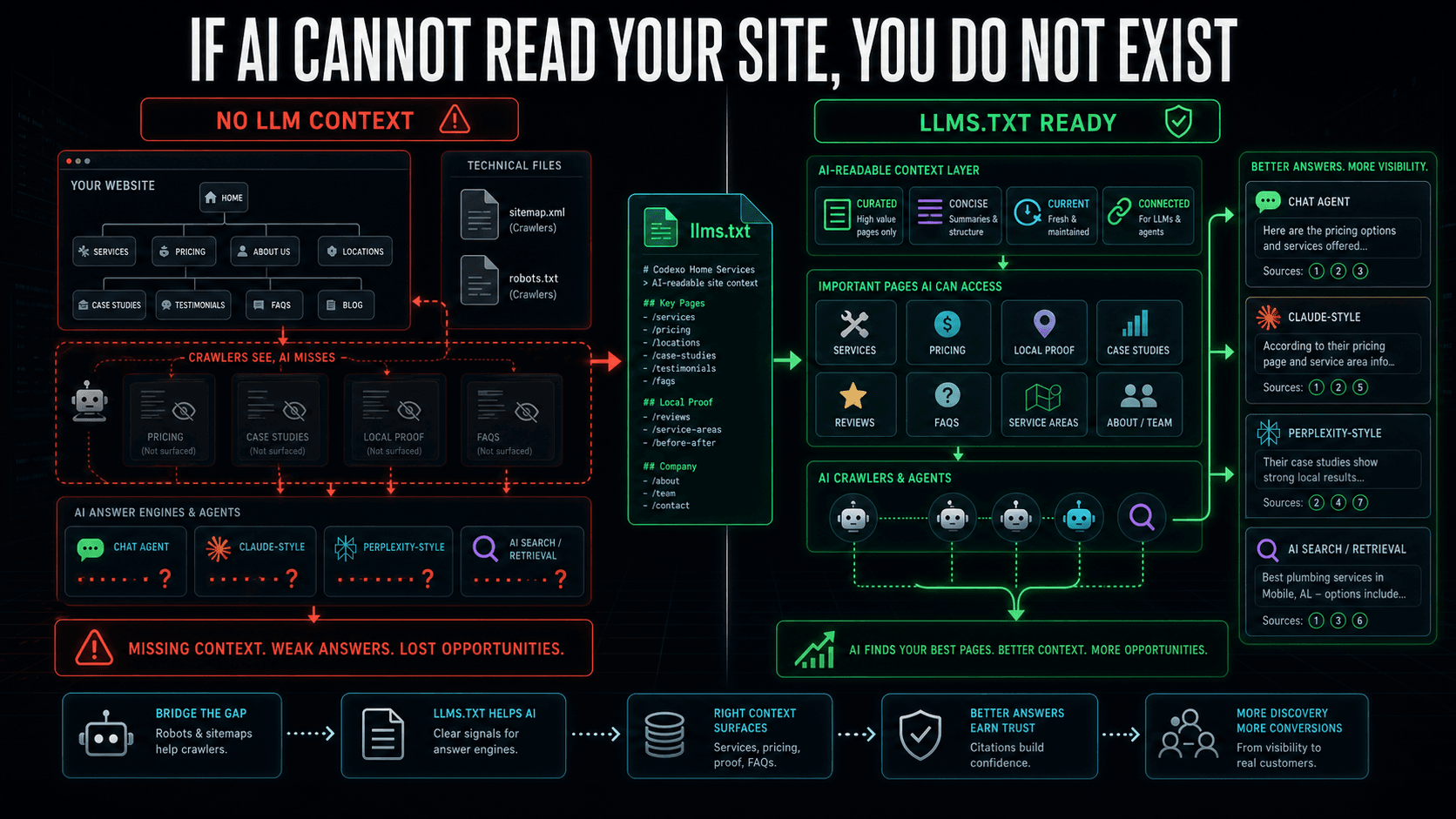
AI search is becoming a recommendation layer, not just a search box
Customers are no longer only clicking through ten blue links. They ask AI systems which company to call, what provider looks credible, what services matter, what pricing to expect, and which business appears active enough to trust.
That changes the job of a website. The site still has to rank, convert, and support traditional SEO. But it also has to be easy for AI systems to understand. If the important pages, proof, services, pricing context, FAQs, and local coverage are buried behind vague navigation, the business becomes harder to retrieve and recommend.
That is the uncomfortable part for agencies. A site can look modern to a human and still be poorly structured for AI retrieval. If the agency does not know the difference, the client may not know they are being missed.
The future buyer may never see your homepage. They may only see what an AI system understood about it.
What llms.txt actually is
The file is called llms.txt. It is a proposed convention that places a markdown file at the root of a website, usually at /llms.txt, so large language models and AI agents can find a clean, curated guide to the site.
Think of it as a map written for AI retrieval. It can point to the most important service pages, product pages, pricing pages, documentation, case studies, FAQs, location pages, and proof that the model should understand before it summarizes or recommends the business.
This is not a confirmed Google ranking switch, and it should not be sold like one. The value is simpler: if AI systems are going to read and summarize your site, give them a structured path to the information that matters.
If your agency does not know about it, they are probably still optimizing for the old search surface
The agencies still treating SEO as titles, meta descriptions, monthly blogs, and a ranking report are missing the bigger shift. AI systems care about retrievable context. They need clear source material, clean page hierarchy, specific answers, and a way to find the strongest proof quickly.
That does not mean every site without llms.txt disappears. It means the business is leaving AI-readiness to chance. When competitors start publishing cleaner context files, better service pages, stronger local proof, and clearer FAQ structures, AI systems have less work to do to understand them.
The fear-based version is true enough to pay attention to: if your agency has never brought up AI-readable site context, they may not be preparing you for where discovery is moving.
Local businesses need this even more than software companies
Local service businesses are messy to understand. They have service areas, emergency services, seasonal work, different offers, review proof, photos, Google Business Profile activity, city pages, and questions that vary by trade.
That is exactly why llms.txt matters as part of the larger Codexo strategy. The file can help point AI systems toward the pages and context that explain what the business does, where it works, what problems it solves, and why it should be considered.
When paired with Google Business Profile activity and Agentic SEO, this becomes a stronger local discovery loop. The profile shows trust and activity. The website shows depth. The llms.txt file helps AI systems find the right context faster.
How Codexo treats llms.txt inside the AI search stack
We treat llms.txt as part of AI search infrastructure. It belongs beside the sitemap, robots rules, schema, local service pages, FAQs, GBP strategy, and content engine. It is not a replacement for any of those pieces.
The Codexo approach is to make the site readable from multiple angles. Traditional search gets structured pages and technical hygiene. Local search gets Google Business Profile activity and review systems. AI search gets cleaner context, stronger answer pages, and a curated llms.txt file that points retrieval toward what matters.
That is the new standard. If the market is asking AI systems for recommendations, the business needs to be understandable to those systems before the recommendation is made.
Your site needs to be readable where buyers are searching now.
We can audit whether your website, Google profile, service pages, and llms.txt context are ready for AI search discovery.
Book a Strategy Call