Guessing Who to Call Next Is Pipeline Self-Sabotage
Sales teams lose time when every lead looks equally important. The intelligence layer Codexo is building is designed to grade prospects, expose urgency, and recommend the next best action before the team wastes the best call window.
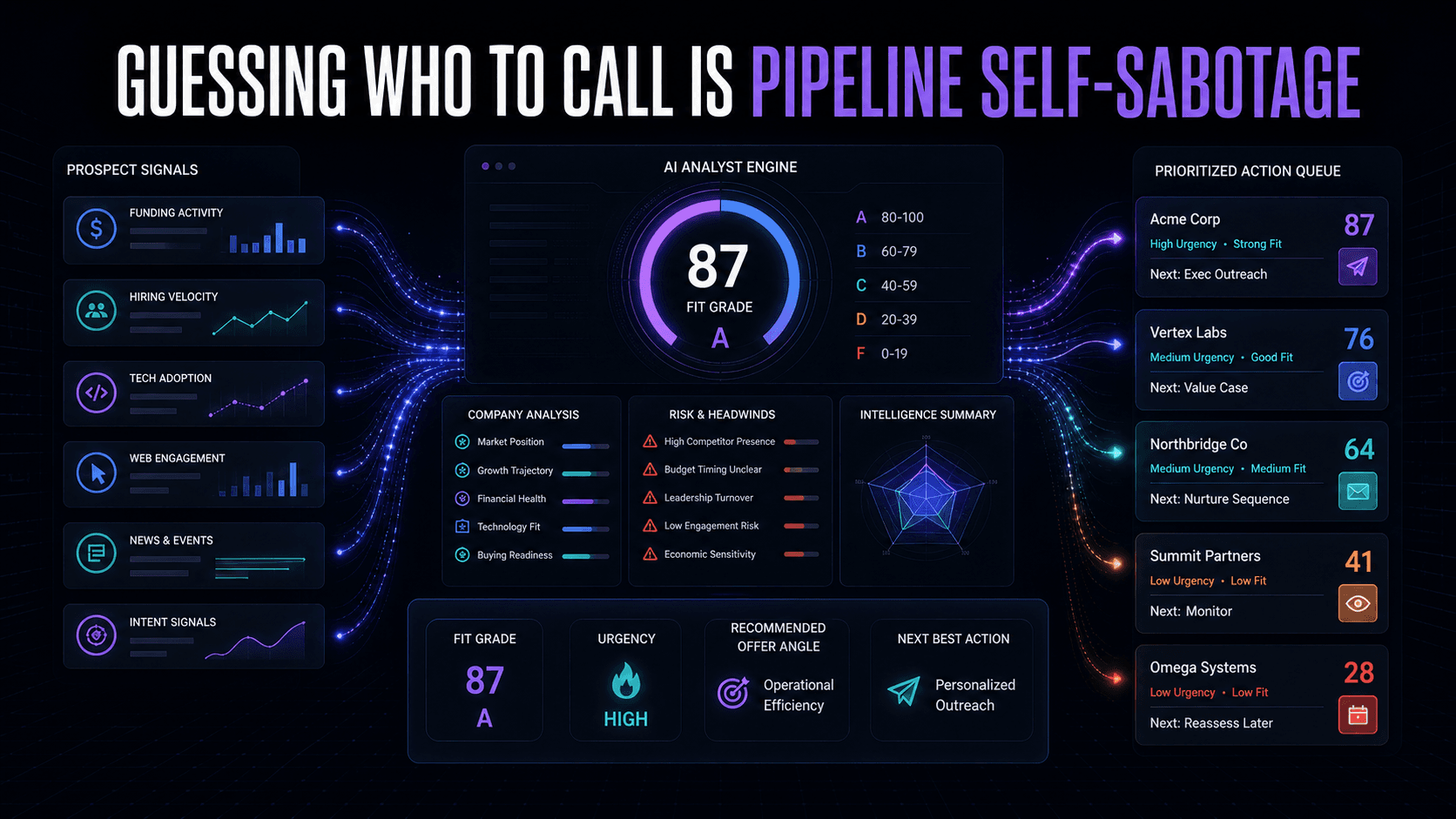
The worst pipeline is the one where every lead looks equal
A busy pipeline can hide the truth. Some leads are ready for a call. Some need education. Some are a bad fit. Some look small but have a clear pain. Some look big but have no urgent reason to move.
If the CRM does not make those differences visible, the team starts guessing. They call whoever is newest, whoever replied last, or whoever feels familiar. That is not strategy. It is pipeline self-sabotage.
The cost is not only wasted time. The cost is calling the right lead too late while spending energy on accounts that were never likely to move.
A lead queue without intelligence makes the team feel busy while opportunity quietly expires.
The grade should explain what to do next
A useful grade is more than a score. It should explain fit, urgency, risk, and recommended action. It should help the operator understand why a lead deserves attention and what kind of message or call angle fits the account.
That is why our internal systems are moving toward visible grading beside the prospect. The grade is not decoration. It is a decision aid for prioritizing work.
When the grade connects to outreach, the team can move faster without becoming generic. A high-fit account may need a direct call. A medium-fit account may need proof. A colder account may need a slower nurture path.
The intelligence layer has to read more than one signal
Good prospect intelligence looks at company context, role context, timing, offer fit, recent behavior, CRM history, and market signals. Any single signal can mislead. The pattern is what matters.
For the prospect enrichment work inside Codexo Hub, this means turning raw company research into a practical selling view. For the Leads Operating System, it means turning CRM and activity context into a visible priority queue.
Those two systems are connected by the same idea: the team should not have to manually assemble context every time it chooses who to call.
The competitor with better prioritization needs fewer leads
A team with poor prioritization always wants more lead volume because it wastes too much of the volume it already has. A team with strong intelligence can get more from the same pipeline by calling the right people at the right time with the right angle.
That is a dangerous advantage because it compounds quietly. Better prioritization improves conversations. Better conversations improve CRM data. Better CRM data improves the next round of prioritization.
Guessing does not compound. Intelligence does.
Stop letting the CRM hide the next best call.
We can show how grading, enrichment, and lead-state intelligence create a clearer work queue for your sales team.
Book a Strategy Call