Service Fusion and GHL Are Finally Connected for Service Businesses Running 10+ Trucks
Service Fusion is where field work gets scheduled and completed. GHL is where contacts, automations, AI voice, and follow-up live. Codexo now offers the integration layer between the two, built for service businesses that have outgrown manual double entry.
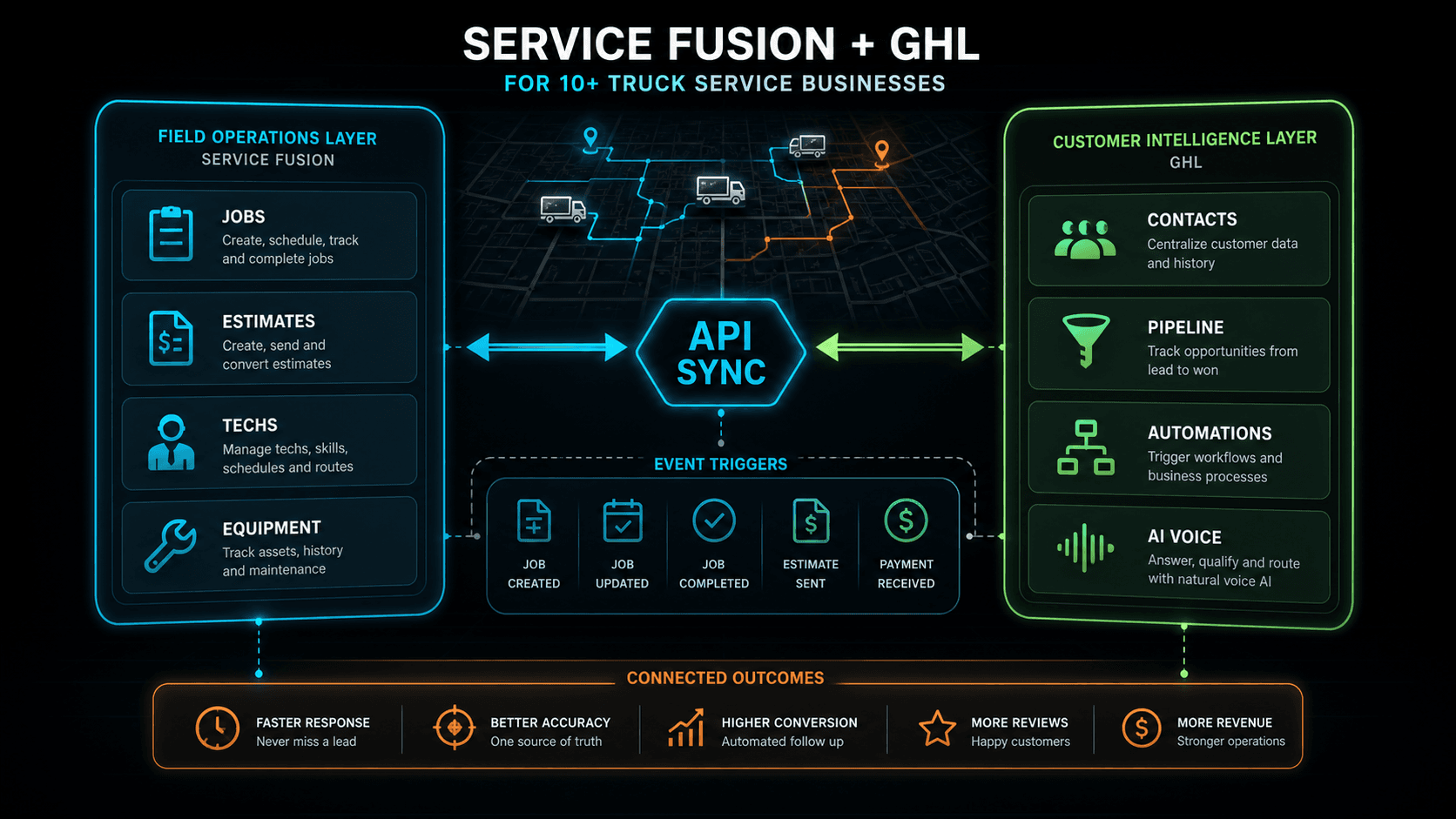
Two systems usually means two versions of the truth
A growing service business needs a field system and a customer system. Service Fusion handles jobs, estimates, technicians, equipment, scheduling, and dispatch. GHL handles lead capture, CRM organization, automations, messaging, and voice AI. Both systems matter.
The problem starts when they do not talk. A booked lead in GHL has to become a customer or job in Service Fusion. A completed job in Service Fusion should trigger follow-up in GHL. A missed estimate should become a revival sequence. Without integration, someone has to remember every handoff.
That handoff problem compounds quietly. One person forgets to update a status. One estimate never gets a follow-up. One completed job never receives a review request. One repeat customer calls again and the intake team cannot see the right history. The business feels busy, but the data trail is broken.
Manual handoff is not an operations process. It is a failure point wearing a headset.
What the integration unlocks
Service Fusion provides API access for Pro plan subscribers, including endpoints for customers, jobs, estimates, technicians, and equipment. HighLevel provides the CRM, messaging, workflow, contacts, calendars, and webhook layer. The Codexo integration uses those capabilities to move operational data between systems.
That means a qualified GHL lead can create or update the right customer record in Service Fusion. Job and estimate status can inform CRM tags and follow-up. Technician or equipment context can be used to improve routing, messaging, and reporting.
The goal is not to mirror every field blindly. The goal is to move the right operational events at the right moment. New lead. Opportunity won. Customer created. Estimate sent. Job completed. Payment received. Missed appointment. Those moments should become triggers for the business.
The workflows this makes possible
A web lead enters GHL, gets qualified by AI voice, and becomes a customer or job in Service Fusion once the opportunity is ready. A Service Fusion estimate gets sent, and GHL starts a follow-up sequence that references the actual service category and urgency. A completed job sends the customer into review, referral, and future maintenance workflows.
For unsold estimates, the integration is even more important. Most service businesses lose money in the estimate follow-up gap. If an estimate sits without response, GHL can trigger SMS, email, and voice touches that are timed to the actual estimate event instead of a generic nurture list.
For repeat work, completed jobs can feed seasonal reminders and reactivation campaigns. The system can know who had service, when it happened, what category it was, and when the customer should hear from the business again.
Why the 10-truck mark changes everything
Under 10 trucks, owners can often brute force the gaps. They know every job. They remember the repeat customers. They can ask the dispatcher what happened. Over 10 trucks, memory breaks. The business needs systems that keep the truth synchronized.
At that size, GHL becomes the organization and automation brain. Service Fusion remains the field execution system. AI voice sits in front of the phones. The integration keeps each layer fed with the data it needs to act.
This is also where staff specialization starts to create blind spots. Sales knows the lead. Dispatch knows the schedule. Technicians know the job. Accounting knows the invoice. The customer experiences one company, but internally the company is split across tabs. Integration brings the story back together.
What Codexo now offers
Codexo now offers the Service Fusion to GHL integration as part of our operating-system builds for service businesses. We map the current workflow, identify the source of truth for each object, define the trigger events, and build the API layer that moves data without creating duplicate chaos.
We also build the GHL side around the integration. That includes tags, pipelines, notifications, workflow triggers, AI voice intake, missed-call handling, estimate follow-up, review generation, and reporting that makes sense to the owner.
The value is not just technical connectivity. It is operational design. Bad integration moves bad data faster. Good integration decides what should move, when it should move, and what should happen next.
The outcome is faster response and cleaner operations
The point is not a flashy integration diagram. The point is fewer dropped leads, cleaner customer records, faster callbacks, better estimate follow-up, and less time spent copying data between tabs.
When the systems are connected, the business can run automations that depend on real operational events. New customer created. Estimate sent. Job completed. Technician assigned. Payment pending. Those events should drive follow-up automatically.
That is how a service business gets leverage. The team does not have to remember the process. The process is built into the system. Humans still make decisions, but they stop carrying every reminder in their heads.
Running 10+ trucks with disconnected systems?
We will map your Service Fusion and GHL handoffs, then show where the API connection removes manual work and improves follow-up.
Book a Strategy Call