Your Voice AI Is a Liability If It Cannot See the CRM
A voice agent that only hears the call is not an operating system. It is a faster receptionist with blind spots. The next phase of voice AI belongs to teams that connect every conversation to account history, lead status, appointment rules, and follow-up logic before the caller hangs up.
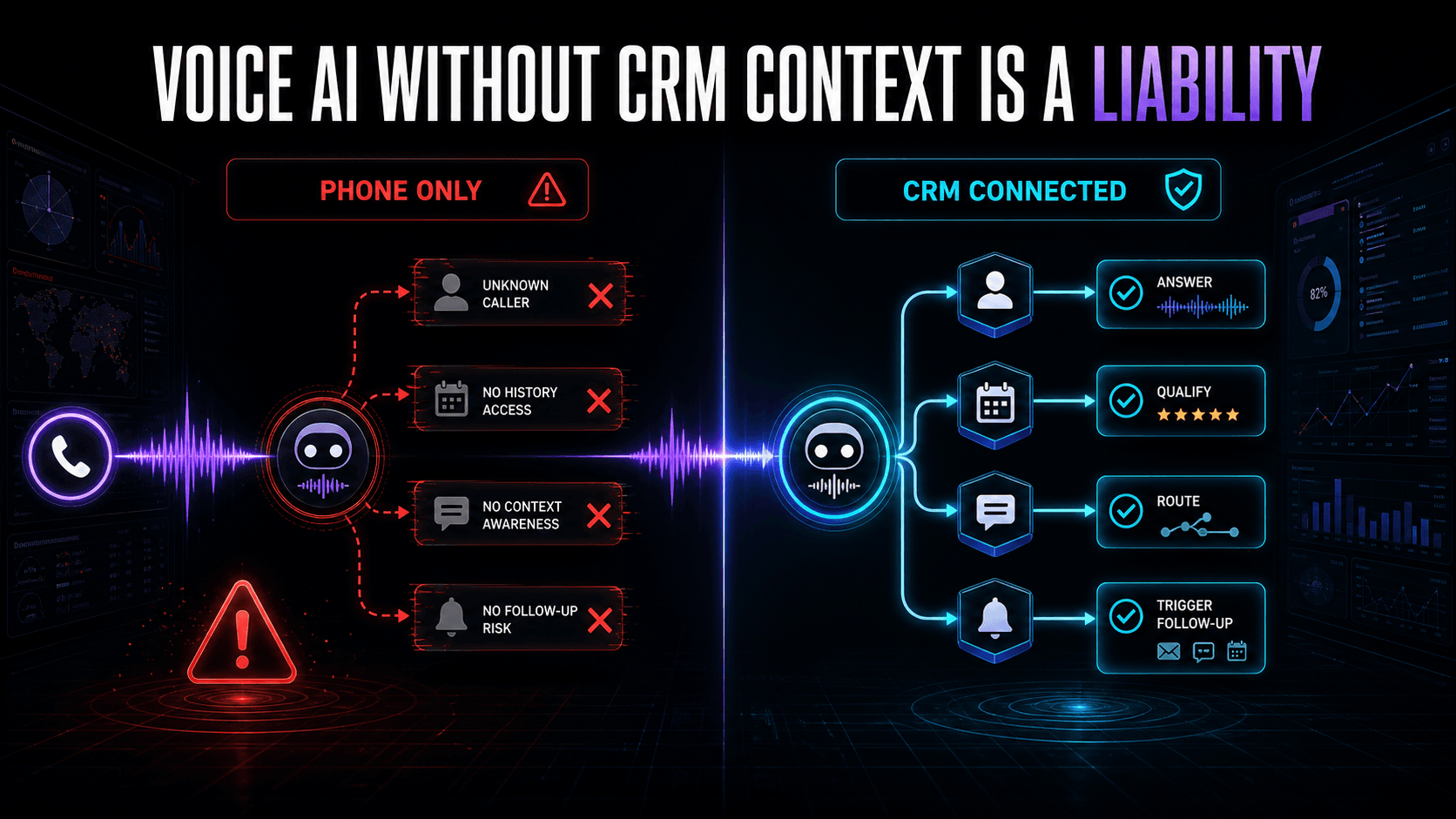
The dangerous agent is the one that sounds good but knows nothing
Most voice AI demos focus on the voice. The agent sounds natural, handles objections, and avoids awkward pauses. That matters, but it is not enough. If the agent cannot see whether the caller is new, active, unqualified, overdue, or already in the pipeline, it can create confident mistakes at scale.
A caller who already requested a quote should not be treated like a brand-new lead. A repeat customer with an open issue should not be forced through generic intake. A high-intent prospect should not be routed into the same follow-up path as someone asking a casual pricing question.
That is why voice AI without CRM context becomes a liability. It can answer quickly while still sending the wrong message, missing the real urgency, or creating duplicate records that make the team trust the system less.
The voice is the interface. The CRM context is what keeps the agent from making expensive guesses.
The new standard is answer, qualify, update, and trigger
The phone call should not be the end of the workflow. It should be the start of a clean operating sequence. The agent answers, qualifies the need, updates the contact, writes the important notes, checks the next best action, and triggers the correct follow-up.
That means the agent needs access to the business rules that actually matter. Service areas, booking windows, emergency criteria, open opportunities, prior objections, appointment history, and notification rules all change what the agent should do next.
The companies that win with voice AI will not be the ones with the flashiest demo. They will be the ones that make the agent part of the same system their sales, service, and operations teams already use.
How Codexo is building the CRM-connected layer
Our current voice work is moving toward context-first intake. We want the agent to know whether a call belongs to a new lead, a stale prospect, an active customer, or a high-priority account before it decides what to ask or what to trigger.
That changes the prompt architecture. Instead of writing one generic script, we build conversation paths around lead status, service category, urgency, and the business outcome the owner actually wants. The agent should not just sound helpful. It should move the record forward.
When that works, the team gets cleaner notes, fewer duplicate contacts, faster notifications, and a better sense of which callers need human judgment. Voice AI stops being a phone tool and becomes the front door to the operating system.
The risk is not AI replacing calls. The risk is bad AI creating hidden cleanup
A bad voice agent does not always fail loudly. Sometimes it quietly files the wrong information, misses the buying signal, or creates an automation path that looks correct until the lead is gone.
That is the part owners should fear. A human mistake is usually visible. A system mistake can repeat across every call after hours, every weekend, and every campaign surge.
The fix is not to avoid voice AI. The fix is to stop treating it like a standalone caller and start treating it like a context-aware operator connected to the CRM, calendar, message history, and follow-up rules.
Voice AI should not be guessing from a blank screen.
We will map your current intake flow and show where CRM context can turn voice AI into a controlled operating layer.
Book a Strategy Call